
For nearly four decades, M. Whitfield has been one of the most respected names in American digestive health. As Director of the Digestive Health Division at the Cleveland Medical Research Institute and a former consulting specialist at three major university hospitals, she has personally treated over 14,000 patients suffering from chronic constipation, IBS, diverticulitis, leaky gut, and severe digestive disorders.

M. Whitfield
Director of Digestive Health, Cleveland Medical Research Institute · 38 years of practice · 14,000+ patients treated
Last month, Whitfield agreed to sit down with me for an on‑the‑record interview. What she told me has had the medical establishment quietly furious ever since.
"I've stayed silent for too long," she said, not breaking eye contact. "Americans over 45 are dying – slowly – from problems that start in the gut, and 90% of my colleagues are still treating the wrong thing. They're treating the symptom. They've never looked at what's actually coating the inside of your intestines."
The autopsy she can't forget
Whitfield leans forward, choosing her words carefully.
"He was 58 years old. A construction foreman from Akron, Ohio. Married, three grown kids, six grandkids. He'd been dealing with what his family practitioner called 'normal aging' – bloating, irregular bowels, low energy, brain fog. Nothing alarming on paper."
"He took fiber supplements. Drank his water. Followed every single thing his practitioner told him for over 12 years."
"Then one Tuesday morning, his wife woke up to find him collapsed on the bathroom floor. By the time the ambulance arrived, he was gone. The official cause of death? Acute septic shock from a perforated colon."

She pauses.
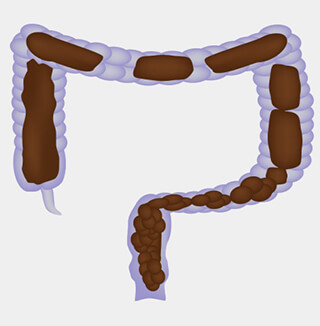
"When I opened him up, I found something that haunts me to this day. Over 19 pounds of compacted, blackened waste material adhered to the walls of his large intestine. Not feces. Not in the way most people picture it. This was a thick, leathery coating – like someone had lined his colon with rotting tar."
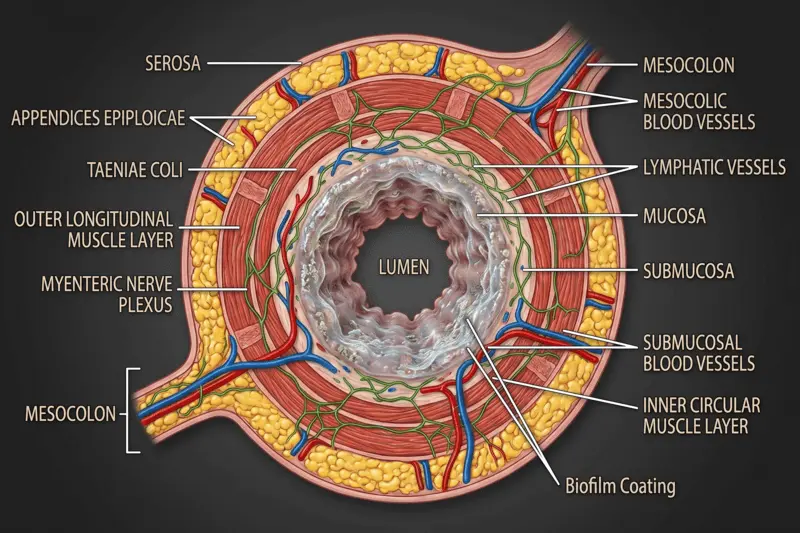
What killed him wasn't constipation. It was the slow, silent poisoning that had been happening inside him for years – long before he ever felt sick enough to call it a problem.
"And here's what I want every American over 45 to understand," Whitfield said, looking directly at me. "He had no idea this was happening. None. His blood pressure looked normal. His cholesterol was fine. His practitioner told him he was 'aging well.'"
"That coating? It was killing him from the inside for at least a decade. And right now, as you're reading this, there's a very good chance the same thing is happening inside you."
The 11 warning signs most Americans over 45 ignore
"In my 38 years," Whitfield continues, "I've identified a very specific cluster of symptoms that almost always means the same thing: your intestinal walls are being coated and your bowel function is being slowly strangled."
She wanted me to write them all down. Here they are.
- 01Bowel movements less than once a day – even when you "feel like you should go."
- 02Hard, dry, pellet‑like stools that take real effort to pass.
- 03Bloating that gets worse as the day goes on – your belt feels tighter at dinner than at breakfast.
- 04Excessive gas that's foul‑smelling and sometimes painful to hold in.
- 05That "never quite empty" feeling after using the bathroom.
- 06Brain fog and afternoon fatigue that hits like a brick wall around 2 PM.
- 07Skin breakouts, dullness, or rashes that came out of nowhere after age 45.
- 08Dull lower‑back ache specialists can't explain.
- 09Sudden food sensitivities to things you used to eat fine.
- 10Bad breath that won't go away no matter how often you brush.
- 11Unexplained weight gain around the midsection – even when you eat the same as always.
"If you said yes to three or more," Whitfield warned, "I want you to keep reading. Because what's happening inside you is far more serious than your practitioner has told you."
How gut dysfunction spreads through the body
– 11 symptoms, 1 root cause –
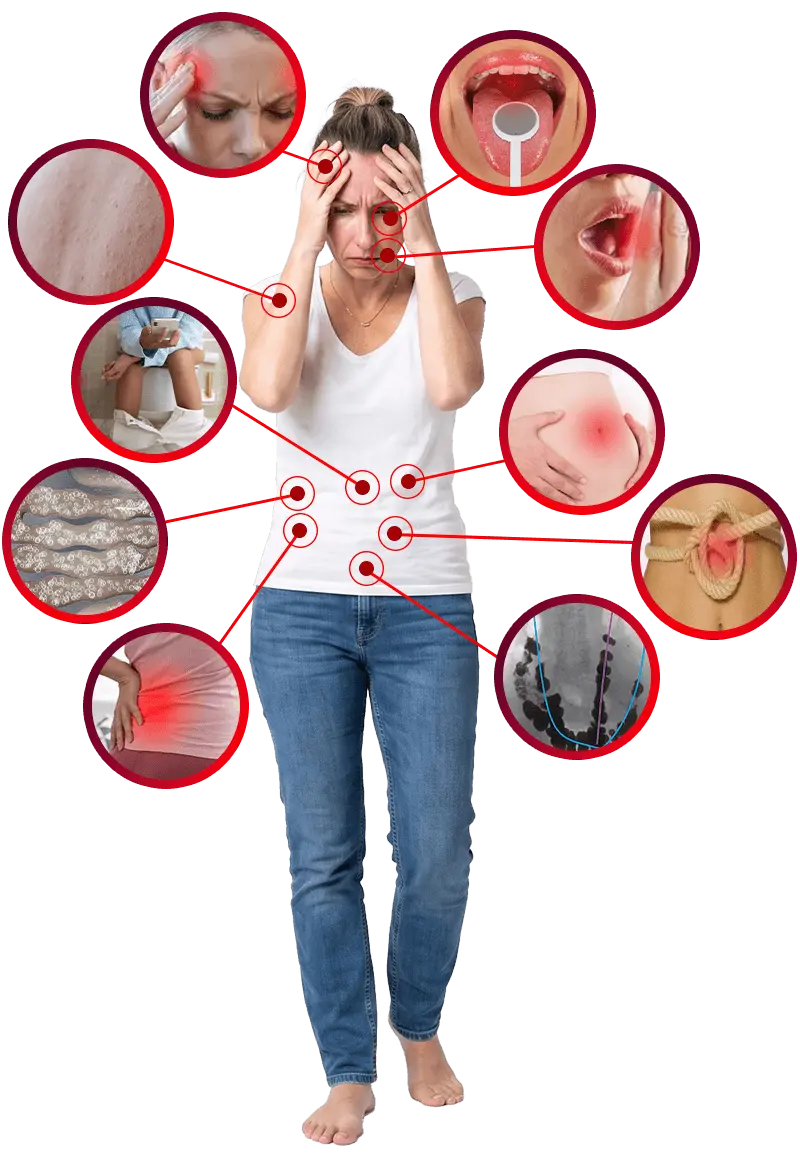
Every symptom from the list above is downstream of one mechanical problem in the colon.
Fix the source – the symptoms resolve.
The patients she will never forget
Whitfield, what actually happens to people who don't address this in time?
"I'll share two cases. I won't use real names. But every detail is what actually happened."
Case No.1 · "Carol" · Cleveland, OH · Age 61
Carol was a retired schoolteacher. Three grown sons, one of whom is a paramedic. She came to Whitfield complaining of "stubborn constipation." That was her exact word – stubborn. Like it was a mild inconvenience.
She'd been taking over‑the‑counter laxatives almost daily for seven years. Senna pills. Stool softeners. Magnesium citrate when things got really bad. Her family practitioner had told her to "drink more water and eat more salads."
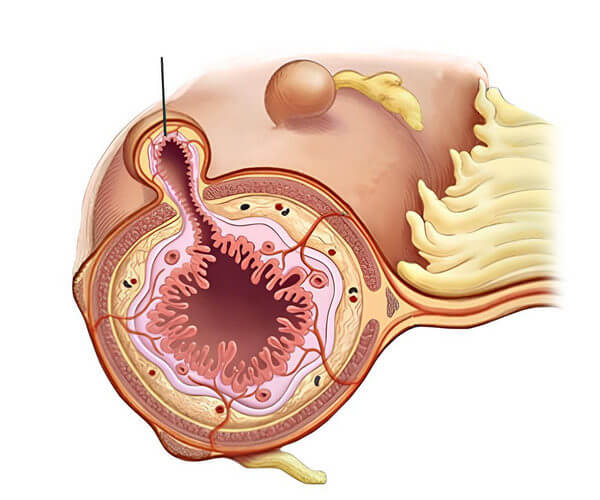
By the time she got to Whitfield, her colon was so distended and so packed with hardened material that the X‑ray looked like she'd swallowed concrete. They measured roughly 14 pounds of impacted waste. Her bowel walls had developed diverticula – small pouches where waste was rotting and breeding bacteria.
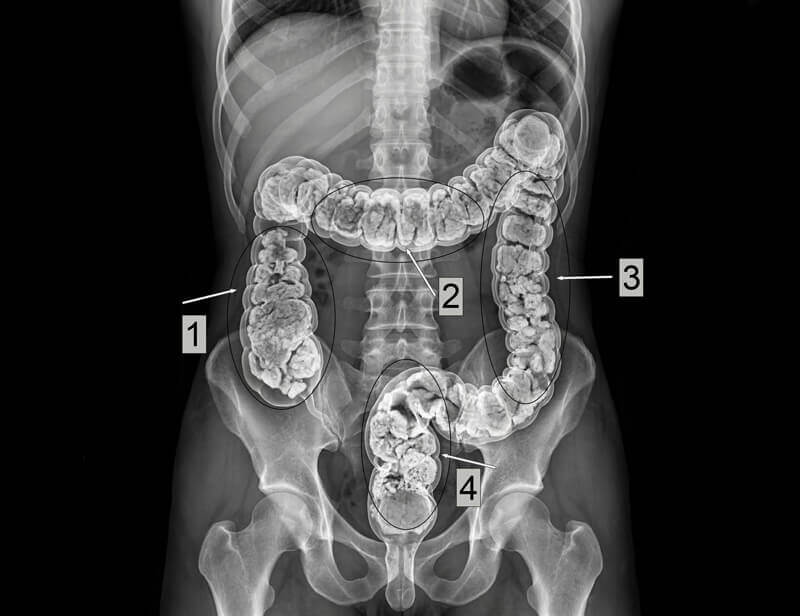

And the worst part? She told Whitfield afterward, sitting in the recovery room with tears running down her face: "If I had known, I would have done anything. Anything. I just thought it was something old people deal with."
Case No.2 · "Robert" · Tulsa, OK · Age 54
Robert was a long‑haul trucker. Tough guy. Never complained about anything. His wife dragged him into the ER one night because he'd been doubled over with abdominal pain for two days and she thought it was appendicitis.

It wasn't appendicitis. It was septic shock from a perforated colon. Bacteria from his backed‑up gut had leaked through the intestinal wall and entered his bloodstream. By the time he was on antibiotics, he had less than a 30% chance of surviving the night.
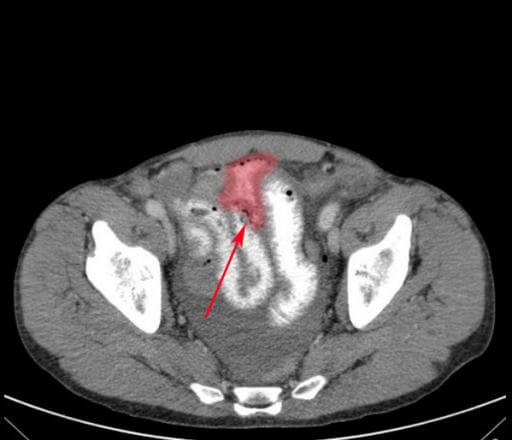

He survived. Barely. Twenty-three days in the ICU. Over 40 lbs lost. Permanent kidney damage. His trucking career, over. His wife took a second job to cover the medical bills.
"And here's the part that should make every American furious," Whitfield said, voice hardening. "None of this gets discussed at your annual physical. Not one bit of it."
Why has nobody told you this before?
Why isn't this a national health emergency?
Whitfield sighed. "I've been asking that question for 25 years. The honest answer? There's no money in solving the root cause."
"The American laxative market is worth over $1.4 billion a year. Stool softeners, fiber powders, gut motility drugs – all of them are designed to do one thing: push waste through the gut faster. They don't fix anything. They don't dissolve what's coating your intestinal walls. They just give you temporary relief."
A customer who needs your product every single day for the rest of their life is a much better customer than one who actually gets fixed.
"Walk into any CVS or Walgreens. Look at the digestive aisle. You'll see 40 different brands of laxatives. Some of them have been around since the 1950s. Why hasn't anything actually been solved in 70 years?
Because the goal was never to solve it."
She let that sit for a moment. "Most people are only told to manage the symptom, not what's underneath it – that's the part we focus on."
The hidden enemy
So what IS coating the inside of people's intestines? What did your colleagues miss?
"Two words," Whitfield said. "Methanogenic biofilm."
"Most people – even most specialists – don't understand what this is. So let me explain it the way I'd explain it to my grandmother."
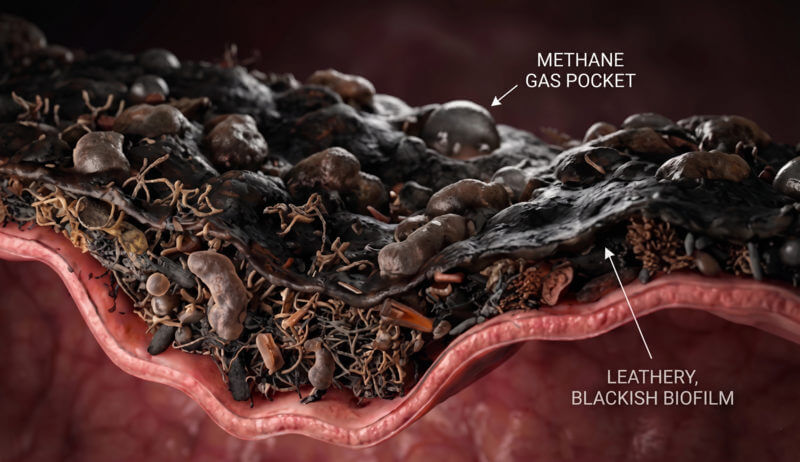
"Inside your large intestine, you have trillions of bacteria. Most of them are good. But somewhere around your mid‑40s – earlier if you've been on antibiotics, eaten a lot of processed food, or taken acid blockers – a specific kind of microorganism starts taking over. It's called an archaeon, and it produces large amounts of methane gas."
"These methane producers don't just live in your gut. They build a fortress."
"They secrete a sticky polysaccharide matrix that adheres to the inner wall of your colon. Over months and years, this matrix accumulates trapped waste, dead cells, and more bacteria. It builds up into what we call a methanogenic biofilm – a leathery, blackish coating that can be over a quarter‑inch thick by the time someone's in their late 50s."
Here's why it destroys you
1. It physically blocks your peristalsis. Your intestines are supposed to contract in waves to push waste along. The biofilm makes the walls rigid. The contractions can't grip properly. Constipation isn't a "lack of fiber" problem – it's a mechanical obstruction problem.
2. The methane itself slows your bowel. Studies from the Cedars‑Sinai Motility Lab confirmed in 2018 that methane gas paralyzes the smooth muscle of the intestine. The more biofilm you have, the more methane is produced, the slower your gut moves. A vicious cycle.
3. Toxins leak through the damaged wall. The biofilm corrodes the protective mucosal layer underneath it. Bacteria, undigested proteins, and inflammatory compounds slip into your bloodstream. This is what specialists call "leaky gut" – and it's the root of brain fog, joint pain, skin issues, and chronic inflammation.
This is why laxatives don't work. They might force waste through one time. But they leave the biofilm completely intact. The methanogens stay. The wall stays coated. Two days later, you're constipated again – and the damage keeps building.
The real chain of damage
Push waste through once. Don't touch the biofilm. Problem returns in 48 hours.
Methanogenic biofilm coats the intestinal wall, traps waste, releases methane that paralyzes peristalsis.
A synbiotic‑and‑enzyme blend formulated to support a healthy gut microbiome and comfortable, regular digestion.
What changed for her in 2021
"For most of my career," Whitfield said, "I knew about biofilms. I knew about methanogens. But I didn't have a tool I could actually give my patients. The pharmaceutical options were brutal – multi‑week antibiotic courses with terrible side effects, and even then, the biofilm came back within months."
"Then in early 2021, a colleague of mine in San Diego sent me a case report. He'd been working with a small independent research group that had spent four years studying the gut microbiomes of populations where chronic gut disease is almost unheard of – the exact bacterial strains, prebiotic fibers, and plant enzymes that keep those guts running clean. What they found stopped me cold."
"They had built a precise combination – four living probiotic strains, six prebiotic fibers, a set of plant‑derived digestive enzymes, and three polyphenol botanicals – a combination designed to work together: plant enzymes for digestion, live cultures to support microbial balance, and prebiotic fibers to support regularity. A gentle formula suitable for daily use."
"The specific blend matters. The morning sachet carries the inulin, FOS and GOS prebiotic fibers, resistant dextrin, the Lacticaseibacillus rhamnosus and Bifidobacterium longum cultures, plus grape seed, pomegranate and turmeric to calm the inflamed lining. The enzyme caplet – protease, amylase, lipase, glucoamylase, invertase, diastase, papain and bromelain – is what actually digests the compacted matrix the biofilm is built from. One feeds and rebuilds. The other breaks down. Together, they do what no single laxative ever could."
What the formula is
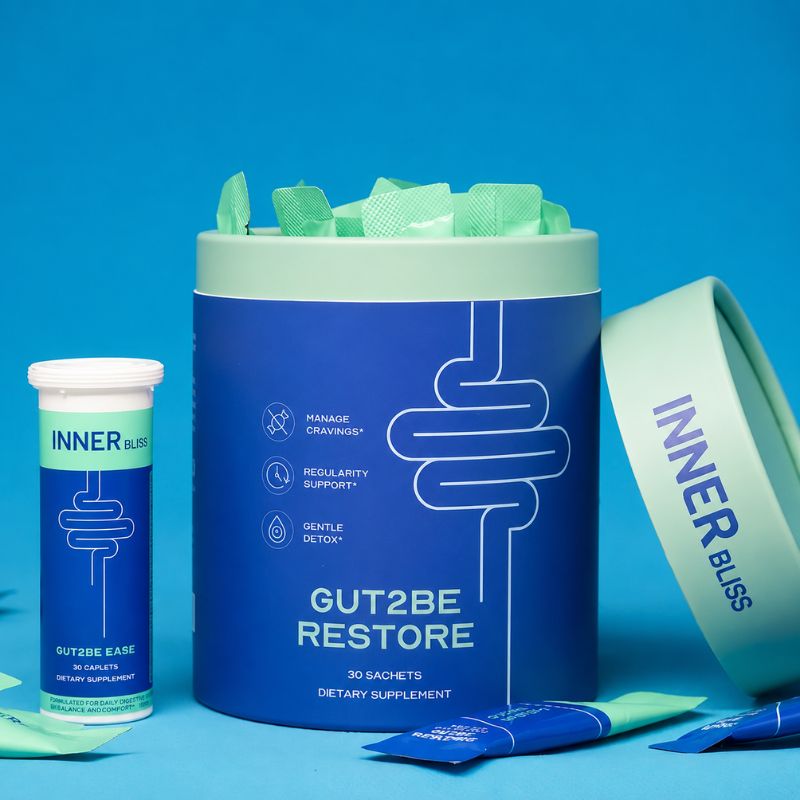
The product is called Gut2Be. A small-batch synbiotic‑and‑enzyme system delivered as single‑serve daily Restore sachets paired with digestive enzyme caplets, produced exclusively in the United States. It is not sold in pharmacies, drugstores, or on Amazon – and that's intentional.
Gut2Be isn't a stimulant laxative. It's a daily synbiotic‑and‑enzyme routine formulated to support a balanced gut microbiome and comfortable, regular digestion.
How you use it
"Beautifully simple. That was important to us."
- 01Tear open one Gut2Be Restore sachet and stir it into a glass of water, juice, or a smoothie first thing in the morning. No scooping, no measuring.
- 02Take one digestive enzyme caplet with the heaviest meal of your day – the meal with the most fat or calories – to break down food and cut the after‑meal bloating.
- 03Repeat every day for the recommended course. Sachet in the morning, caplet with your big meal. That's the entire protocol.
"You don't need to change your diet. You don't need to fast. You don't need to do anything heroic. The synbiotic blend and the enzymes work whether you're eating a salad or a bacon cheeseburger. Just take your sachet and caplet daily for the recommended course."
Week by week – what to expect
Three of Whitfield's patients, in their own words

P. Martinez, 62 · Houston, TX
Retired nurse
I'd been dealing with this for almost fifteen years. I just thought that was my life – once‑a‑week bathroom trips, constantly bloated, low energy. A few weeks into taking Gut2Be, things started to feel different – more regular, way less bloated. I found myself relying a lot less on my usual go‑to's. By week six, I felt lighter and more like myself than I had in years. I actually got a little emotional about it.

F. Russo, 57 · Pittsburgh, PA
Steel mill supervisor
I'm not a supplement guy. I drink coffee. But I was up to a six‑pack‑a‑week of stool softeners and the specialist was talking about a colonoscopy. Two weeks on Gut2Be, my afternoon brain fog – gone. Three weeks later, regular every morning like clockwork for the first time since my 40s. I just call it relief.

L. Brooks, 54 · Atlanta, GA
Office manager
I'd tried every probiotic, every fiber powder, everything I could think of. Nothing held. The bloating was so bad I'd unbutton my pants in the car. I started Gut2Be in October. By Thanksgiving I ate a normal‑sized plate and went to the bathroom the next morning without thinking about it. My husband said I seem like myself again.
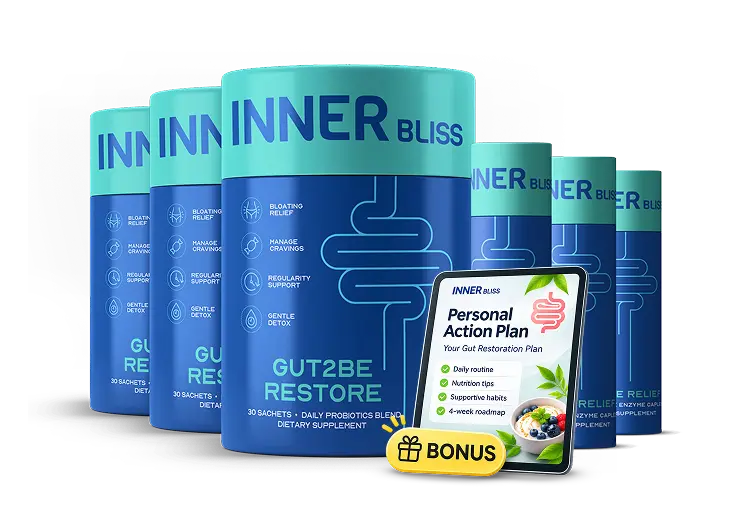
Whitfield's Recommended Formula
Order Gut2Be
Synbiotic + enzyme system · Single-serve sachets & caplets · FDA-registered facility
Order Now – 60% OFFOne last question. Why isn't Gut2Be sold in pharmacies or on Amazon?
"Two reasons. First, the manufacturer made a deliberate decision to keep distribution direct‑to‑consumer to control quality and prevent counterfeits. Second – and I'll say this honestly: if Gut2Be sat on the shelf at CVS next to laxatives, the laxative companies would have lawyers in the building within 48 hours. So the manufacturer chose to stay independent, sell direct, and protect the formula."
Her closing words: "Don't wait until you're Carol or Robert. Order Gut2Be while it's still in stock. The discounted batch sells out quickly every month."
– More from The Longform –
What your stool is trying to tell you: a digestive health specialist's field guide















K. S.
2 days ago
I'm 58 and I have literally every single one of those 11 symptoms. Every. Single. One. I've been telling my specialist for years and she just keeps saying "drink more water." I just ordered Gut2Be, fingers crossed.